Ask most people in Dublin when they last went into their attic and you’ll get a vague answer. Christmas, maybe. The year they moved in. Never, because the hatch is in an awkward spot and the ladder sticks. That’s normal. The attic is the one room in the house nobody lives in, so nobody looks after it.
The trouble is that the attic still works for you every day. It holds the insulation that keeps your heat in, it ventilates the roof timbers, and it sits directly above the bedrooms you sleep in. When it gets dirty, damp or infested, you usually notice the effects downstairs long before you notice the cause.
This guide explains what a professional attic cleaning service in Dublin actually involves, what it can and can’t fix, and the signs that tell you it’s time.
What builds up in a Dublin attic
An attic isn’t sealed. Air moves through it from the eaves and from the house below, and it brings things with it. Over ten or twenty years you typically find:
- Fine dust and fibres drawn up from the rooms below through gaps around light fittings, pipes and the hatch.
- Degraded insulation. Older mineral wool slumps, compresses under stored boxes and gets wet from small roof leaks. Once it’s flattened or damp, it barely insulates at all.
- Mould on the roof timbers and felt, usually on the north-facing slope where the sun never dries it out.
- Droppings and nesting material from birds, mice or rats. In older Dublin housing stock this is far more common than people expect.
- Clutter. Old suitcases, cardboard boxes that have gone soft with damp, broken furniture, paint tins from three owners ago.
None of this is dramatic on its own. Together, it makes the attic a source of allergens and musty smells, and it makes your heating work harder than it should.
Why Dublin’s climate makes it worse
Dublin isn’t the wettest part of Ireland, but it is consistently mild and humid. Long stretches of grey, damp weather mean the air in a roof space rarely gets the chance to dry out properly. Warm, moist air rising from showers, cooking and drying clothes indoors then meets a cold roof deck, and it condenses. That’s the cycle behind most attic mould we see, from 1930s terraces in Crumlin and Drimnagh to 1990s estates in Lucan and Swords.
Homes that have had extra insulation stuffed in without anyone checking the ventilation are often the worst. The insulation blocks the airflow at the eaves, the roof can’t breathe, and condensation has nowhere to go.
What a professional attic clean involves
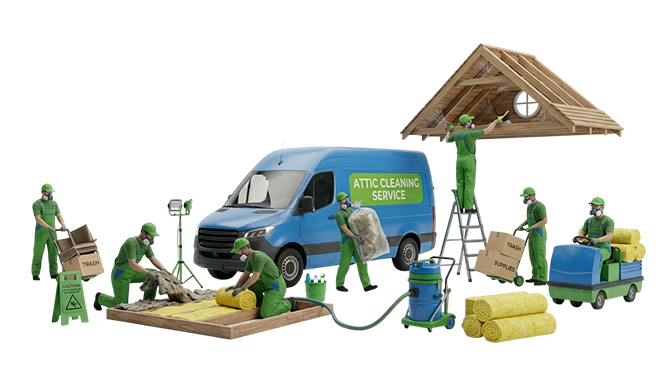
A proper job is more than someone going up with a hoover. At BioClean, a typical attic restoration follows these stages:
1. Inspection and sorting
We look at the whole space first: the condition of the insulation, any mould on the timbers, signs of pests, leaks around chimneys and valleys, and how well the roof is ventilated. If you have stored items, we help you sort what stays from what goes.
2. Clearing and debris removal
Rubbish, contaminated boxes and old materials are bagged and taken out. Where there’s a lot, it can go straight into a skip on site.
3. Deep cleaning from the top down
We work from the ridge down using industrial HEPA-filtered vacuums, so the fine dust is captured rather than blown around. HEPA matters here, because attic dust is exactly the kind of fine particle that a normal vacuum just recirculates.
4. Insulation removal where needed
Insulation that’s soaked, mouldy, contaminated with droppings or crushed flat comes out. There’s no point cleaning around it.
5. Treatment and disinfection
Mould on timbers is treated with a professional anti-mould product. We then use biodegradable bio-enzyme agents to break down odours and organic contamination, followed by ozone treatment, which reaches behind rafters and into corners that sprays can’t.
6. Re-insulation and ventilation
Once the space is clean and dry, new insulation goes in, and we fix the ventilation if it’s the reason the problem started. Usually that means clearing the eaves or fitting roof vents. Without this step, mould tends to return within a couple of winters.
To be honest about expectations: no attic will ever be sterile, and anyone promising that isn’t being straight with you. The aim is a space that is clean, dry, properly insulated and no longer feeding dust, spores and smells into the house.
Signs your attic needs attention
You don’t have to go up the ladder to spot most of them:
- A musty or damp smell in upstairs rooms, especially on cold mornings.
- Black spotting or staining on bedroom ceilings near the external walls.
- Allergies or a stuffy nose that are worse at night or in winter.
- Scratching or scurrying noises above the ceiling.
- Upstairs rooms that are noticeably colder than downstairs, or heating bills that have crept up.
- Water marks on the ceiling below the attic hatch or near the chimney breast.
If you do look up there, the clear warning signs are dark patches on the underside of the roof felt or boards, wet or flattened insulation, droppings along the eaves, and a strong, sour smell.
When it makes sense to book
Most people call us at one of a few moments: when they’ve bought a house and want to know what’s above them, before selling, when they’re planning to convert or board out the attic, after a pest problem has been dealt with, or when mould keeps reappearing on bedroom ceilings and they’ve run out of ideas.
It also makes sense to clean before any insulation upgrade. Laying new insulation on top of old, contaminated material traps the problem in rather than solving it.
Can you do it yourself?
You can certainly clear out clutter yourself, and it’s worth doing. The deeper work is a different matter. Disturbed attic dust, droppings and mould spores are genuinely unpleasant to breathe, the working position is cramped, and it’s easy to put a foot through a ceiling between the joists. Without a HEPA extraction system and proper protective equipment, a DIY clean often spreads the dust into the house below. Our crews are Safe Pass accredited and trained for confined, high-level spaces, which is what this work is.
Where we work
We’re based in Dublin 12 and cover the whole of County Dublin, from Howth and Malahide down to Dalkey and Rathfarnham, and out to Lucan, Clondalkin, Tallaght and Blanchardstown. We regularly travel to the commuter towns in Kildare, Meath and Wicklow as well. If you’re not sure whether you’re in our area, just ask.
Get a free quote
Every attic is different, so we price each job after seeing photos or the space itself. Call or WhatsApp us on +353 85 735 7237, or send a few details through our contact form, and we’ll come back to you with a free, no-obligation estimate. We work seven days a week, 7am to 7pm.