Gutters are easy to ignore. They’re up high, they work quietly, and you only think about them when water is pouring over the edge onto your front step. By then, the damage has usually started somewhere you can’t see.
In Dublin, the best time to deal with them is after most of the leaves have come down and before the winter storms arrive. In a typical year that window falls between mid-October and late November.
What blocked gutters actually cause
When a gutter fills with leaves, moss and silt, rainwater can’t get to the downpipe. It spills over the front edge or, worse, backs up and runs behind the gutter onto the fascia board and down the wall. Over a winter, that leads to:
- Damp patches on internal walls, often in an upstairs bedroom, that people mistake for condensation.
- Rotten fascia and soffit boards, which then let water and birds into the roof space.
- Water getting into the attic at the eaves, soaking the insulation at exactly the point where it’s hardest to see.
- Green streaks and algae on render and brickwork below the overflow point.
- Ground problems, such as water pooling against the base of the wall or washing out paths and patio joints.
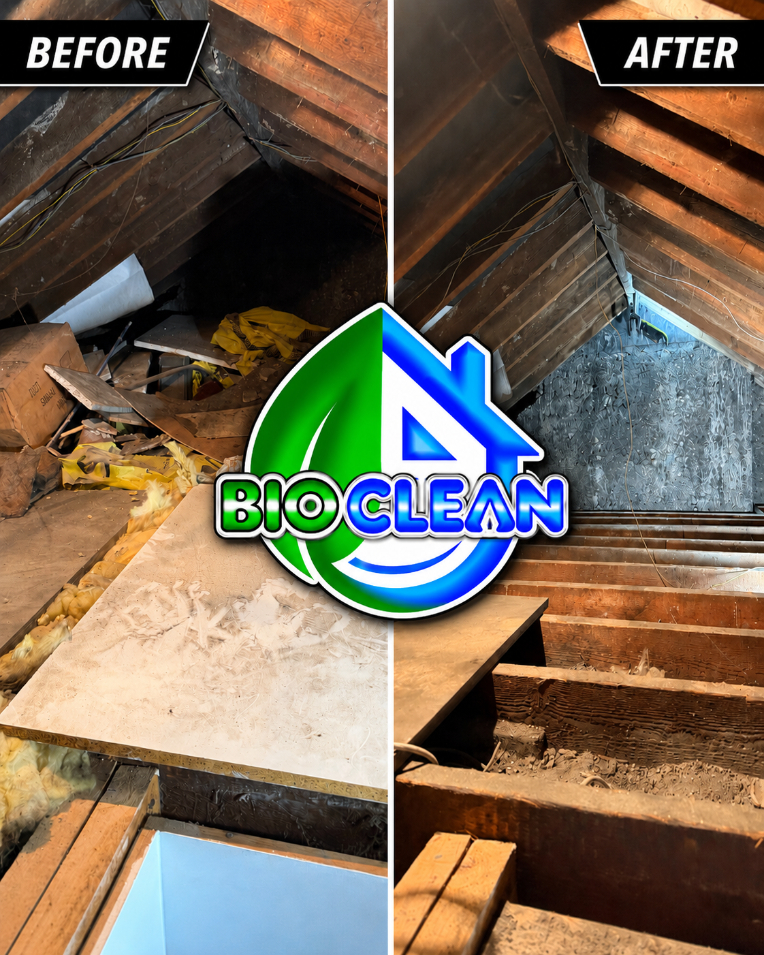
A surprising number of the attic mould problems we treat start with a gutter that has been overflowing for years at one corner of the house.
Why Dublin gutters block so quickly
Three things work against you here. Mature trees are everywhere in Dublin’s older suburbs, from Terenure and Glenageary to Castleknock and Clontarf, and even one sycamore two gardens away can fill a gutter in a fortnight. Moss from the roof washes down with every heavy shower and settles in the gutter as a dense, spongy mat. And the mild, wet climate means that mat rarely dries out, so seeds germinate and you end up with small plants growing along the eaves.
What a proper gutter clean includes
Scooping out leaves is the start, not the job. When we do gutter cleaning, we also:
- flush the gutters and check that water actually reaches the downpipes
- clear blockages inside the downpipes, which is where the real problem often is
- check joints and brackets for leaks or sagging sections that hold water
- look at the fascia and soffits for rot or gaps
- note any slipped or cracked roof tiles and moss build-up we can see from the gutter line
You get a short summary of anything we spotted, so you know whether there’s anything else worth dealing with before winter.
Can you do it yourself?
On a single-storey extension with a solid, level surface underneath, yes, carefully. On a two-storey house, think twice. Ladder falls are a common cause of serious injury in Ireland, and leaning a ladder against a plastic gutter is a good way to crack it. If you do it yourself, use a ladder stand-off, have someone footing the ladder, and never reach sideways further than you can comfortably manage.
A five-minute check from the ground
Next time it’s raining hard, go outside with an umbrella and look up. You’re watching for:
- water spilling over the front of the gutter in a sheet
- drips coming from joints rather than from the downpipe
- plants or grass visible along the gutter line
- a downpipe that isn’t running when everything else is
- dark staining on the wall directly below a section of gutter
Any one of those means the gutter needs attention.
Pair it with a roof check
Gutters and roofs are one system. Heavy moss on the roof will refill the gutters within months, so if your roof is green, it’s worth looking at roof cleaning at the same time. And if water has been getting in at the eaves for a while, a quick look in the attic will show whether the insulation at the edges has got wet.
We work across Dublin and the surrounding counties. For a free quote, call or WhatsApp +353 85 735 7237 or use our contact form.